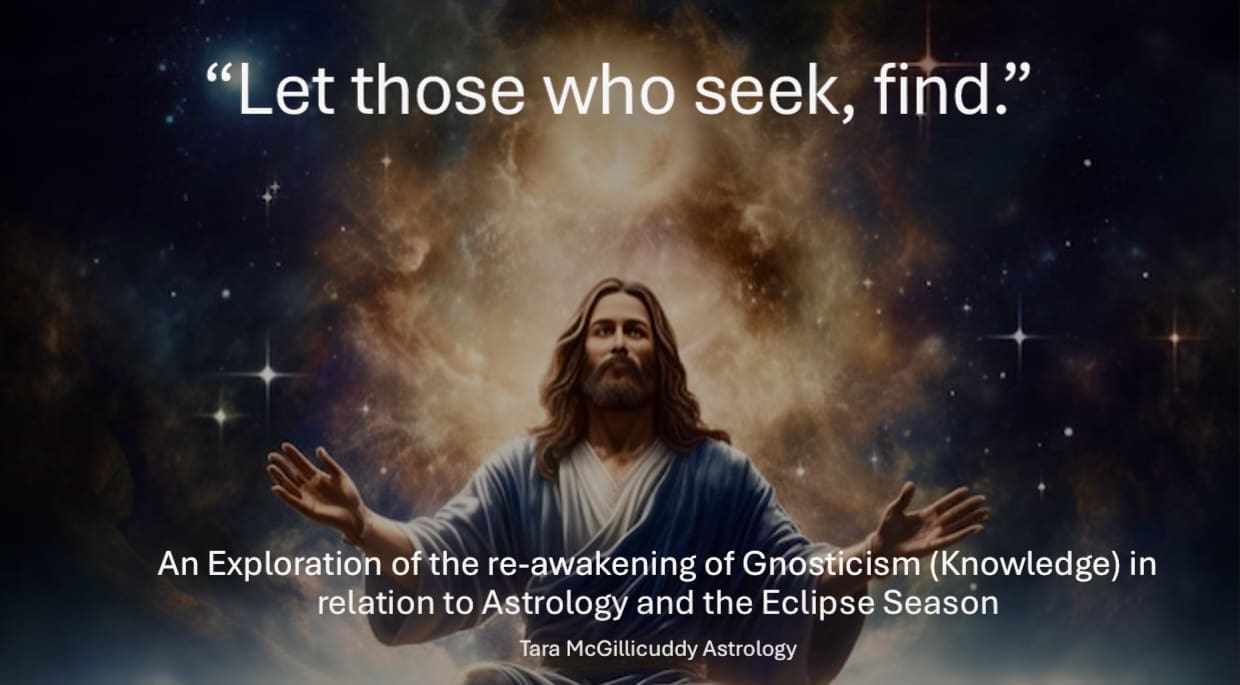
“Let Those Who Seek, Find:” An Exploration of the re-awakening of Gnosticism in relation to Astrology and the Eclipse Season
Before I explore the deeper connections between Gnosticism, Astrology, and the upcoming Eclipse Season, I want to begin by sharing something personal. As I write this, I’m reflecting on my father’s life—today is his birthday. He passed away in 2016, and his death marked a turning point in my life. He was a rock for me, a constant presence. Two years before that, I also lost my grandmother, another steady pillar in my life. I was incredibly close to both of them, and when they died, it felt like parts of me died with them.
For those reading this, I don’t know if you’ve ever lost someone you felt soulfully connected to, but if you have, then you understand the kind of grief that rearranges everything inside of you. I was with both my dad and grandma when they took their final breaths. In those moments, I witnessed something beyond the physical—I felt their Souls leave their bodies. It shook me to my core. I kept asking myself: How could two people so full of life just be… gone? Where did they go?
These questions stirred something deep within me. I had grown up Catholic, taught to believe in Heaven as our final destination. But my grief made those teachings feel incomplete. I needed more. That search led me to Evolutionary Astrology—a language that helped me connect with my Soul for the first time. I began to understand myself as more than just “Tara McGillicuddy” in this one lifetime. I saw myself as a Soul—ancient, evolving, and part of a larger cosmic story. It was then, that I understood death differently. It was no longer just an ending; it was also a beginning. And in that realization, I saw my dad and grandma in a new light, not through their physical lives, but through their soulful journeys.
Around the same time, I discovered the Gospel of Thomas, one of the lost gospels, and it changed everything for me. Though I had always felt a connection to Jesus, reading this text made his words come alive in a way I had never experienced before. It felt intimate, direct—as if he was speaking to me personally. I immersed myself in more of these Gnostic texts, and they echoed what I was learning through Astrology: that divine truth is already within us.
The Hermetic saying “As above, so below. As within, so without” suddenly made perfect sense. This wasn’t just philosophy—it was remembrance. I remembered who I truly was, not just intellectually, but on a Soul level.
My hope in sharing this is that you, too, awaken to the truth already inside you. We are all divinely connected to God and the universe, and we each hold the keys to the kingdom—inside us.
It is undeniable that something is happening right now, collectively. We all feel it, a crying out from deep within. I call this our Soul. It wants to be heard; it wants to be known. This deep stirring arising within us is the signal of Eclipse Season approaching—an ancient rhythm awakening in our bodies and spirits. As the eclipses draw near, this inner current grows stronger. We all feel it like an itch beneath the surface of our skin, impossible to reach, impossible to ignore.
This discomfort—this agitation—is the effect of powerful planetary movements marked by the upcoming Eclipses happening in September. For the purpose of this essay, I’ll be focusing on the Lunar Eclipse in Pisces and its transcendent effect on humanity.
On September 7th, the total Lunar Eclipse will occur in Pisces, marking a moment of cosmic revelation. This eclipse initiates a collective reset, a return to a time when Gnosticism was not heresy, but The Way: the path of Enlightenment, of Knowledge, of Understanding, of God.
But why now? Why is Gnosticism re-emerging in our collective consciousness? And how is it intertwined with Evolutionary Astrology, the Journey of the Soul, and this pivotal Lunar Eclipse in Pisces?
To truly understand the connection between Gnosticism, astrological undercurrents, and the larger spiritual whole, we must first explore what Gnosticism represents. The term “Gnosticism” derives from the Greek word gnosis, meaning “knowledge”—but not just any knowledge. It refers to a sacred, often secret understanding of the divine and one’s true spiritual path. Through gnosis, it is believed that we can achieve salvation and enlightenment.
In ancient times, many early Christians practiced forms of Gnosticism, though they might not have identified as “Gnostic Christians” like we do today. To better understand this movement, let’s turn to the Lost Gospels—ancient Christian texts that were rediscovered in the late-19th and mid-20th centuries after being buried in the Egyptian desert for roughly 1,500 years. These texts, which include a complete copy of the Gospel of Thomas (consisting of 114 sayings attributed to Jesus), are thought to predate the canonical Gospels in the Bible. Among the texts discovered in 1945 near Nag Hammadi in Upper Egypt, were the Gospel of Thomas,the Gospel of Truth, and the Gospel of Peter, to name a few. The Gospel of Mary Magdeline, which I will also be referencing in my writing, was discovered earlier in 1896 near Akhmim, Upper Egypt. Many of these texts are believed to date back to the 2nd Century, and some even earlier, making them quite possibly, older in their origin than the Four Canonical Gospels we recognize in the Bible: Matthew, Mark, Luke, and John.
Unlike the narrative-driven New Testament, these Lost Gospels focus on wisdom and hidden knowledge, offering unique insights into Jesus’ teachings. Unfortunately, they were not included in the official biblical canon established by the early Church. The reasons behind their exclusion remain debated, but many scholars believe they posed a threat to the emerging orthodox teachings of the Church.
One of the key differences between Gnostic texts and mainstream Christian doctrine lies in the conception of God. Traditional Christianity often views God as a distant, external authority to be feared and worshiped. In contrast, the Gnostic tradition teaches that God is within us, not outside of us. If God resides within, why would we need a Church to access the divine? Why rely on a religious doctrine to mediate our connection to God, if its already inside of us? This radical internalization of the divinity directly challenged the Church’s authority, making Gnosticism a danger to the religious establishment and order of the time. For this reason, the Lost Gospels were buried, only to be unearthed when our collective consciousness was ready to receive them. Still, today, many people either don’t know about these texts, or choose to overlook them as anything vital, for they aren’t yet as accepted as the traditional Biblical texts in our mainstream culture.
Now, more than ever, we are called to connect with something greater than ourselves. How we answer this call will be deeply personal, but each of us has the potential to access “Gnosis”—the ancient knowledge buried within us. If only we remember it, this wisdom has never been lost; it only requires our awakening.
We must recall the ancient word of God, the teachings of Jesus in the Lost Gospels, and the timeless truth that God resides within each of us. God is not just something to search for in distant places—God already lives within us. Salvation is not found in external rituals or dogma, but in the inner realization of our divine nature. This realization, this “Gnosis,” or spiritual knowledge, is the path to salvation.
This idea of the divine within us is expressed clearly in the Gospel of Thomas, phrase 24, where Jesus speaks to his disciples:
“His disciples said, ‘Show us the place where you are, for we must seek it.’ He said to them, ‘Whoever has ears should hear. There is light within a person of light, and it shines on the world. If it does not shine, it is dark.’”
Here, Jesus is describing the divine light that exists within every human being. This light, this spark of the divine, is not something we must search for externally. It is already within us, waiting for us to recognize it.
This concept is also echoed in the Gospel of Mary, where Mary Magdalene receives secret teachings from Jesus:
“The Son of Humanity already exists within you. Follow him, for those who seek him will find him.”
In both the Gospel of Thomas and the Gospel of Mary, Jesus tells his disciples to “seek until they find.” This is not a call to look outward, but to look inward. Salvation is achieved through direct connection with the divine spark within us. Gnosis—spiritual knowledge—is the key that opens the door.
But how can we access this knowledge without first understanding that we are connected to something much greater than our physical bodies? One way to deepen our understanding of “Gnosis” is to explore the ancient practice of Astrology. Astrology has been a tool for spiritual insight for centuries, showing us that the movements of the stars and planets are not random, but part of a divine order that reflects our inner world, psychological makeup and our evolving consciousness.
It is undeniable that our consciousness is deeply connected to the movement of the cosmos. As the planets shift and align, we, too, shift—our awareness expanding and evolving in harmony with the universe.
Our birth chart is more than just a map; it is a celestial blueprint of the Soul. It reflects who we’ve been up to the moment we took our first breath, and it holds the infinite potential of who we might become in this lifetime.
But the Soul is not static. Just as the planets continue their orbits after we are born, we continue to change, grow, and evolve. Astrologers speak of planetary alignments not as distant phenomena, but as cosmic events that echo within us—triggering transformation, awakening, and deeper awareness.
We feel their gravitational pull not only on a physical level but also on a spiritual one. Without the planets, Earth would not exist. Their celestial dance holds our world in balance, making life itself possible.
Have you ever heard that we are made of stardust? It’s more than poetic—it’s scientific fact. We are the universe, and the universe is us.
Let’s go deeper into Eclipse season—and the purpose behind this powerful time.
Eclipses are more than celestial events. They act as gateways to Gnosis—moments when we’re offered access to deeper knowledge about our life’s meaning and spiritual path. This isn’t an easy process, but it’s profoundly transformative.
Astronomically, eclipses occur when the Sun and Moon are in opposite signs, and the Earth aligns between them, casting a shadow on the Moon. Symbolically, this represents a disruption in the normal flow between our conscious (the Sun) and unconscious (the Moon) selves.
During an eclipse, the veil thins. Everything we’ve repressed or avoided begins to stir, rising to the surface. This can feel overwhelming—but it’s an invitation to meet ourselves with honesty, even when it’s uncomfortable.
Often, we don’t consciously realize what’s happening. Instead, we experience what astrologers call Eclipse symptoms:
- Emotional extremes: intense highs and lows
- Irritability, moodiness, and unexpected conflict
- Brain fog and sleep disturbances
- Sudden identity shifts or crisis
- Disconnection from self and others
- Unresolved emotions demanding attention
- A deep longing to escape or withdraw
- Forced endings and necessary goodbyes
- Activation of the fight-or-flight response in the autonomic nervous system
All of this discomfort serves a deeper purpose. It’s the itch within—the soul’s signal that something must shift. That change is possible. That transformation is not only coming—but required.
Going even deeper, this Eclipse falls near the Nodal Axis, intensifying the influence of the lunar nodes, which are currently in Pisces and Virgo. The North Node lies in Pisces, where the Moon will be during the September 7th Eclipse, while the Sun is in Virgo, closely aligned with the South Node. This configuration heightens the polarity between past and future, security and growth.
We are all being called to release old patterns and step beyond our comfort zones into the unknown. Naturally, it’s tempting to cling to what’s familiar—after all, the unknown can be terrifying. But it is only by leaving the safety of the known that something new can be born. Remember, nothing new can grow in a comfort zone!
The total Lunar Eclipse is illuminating Piscean themes, bringing the Pisces archetype into our collective awareness. To truly understand Pisces, we must turn to the concept of Gnosis—a deep, inner knowing that transcends intellect and reconnects us with the divine within. Pisces is linked to the pineal gland, the crown chakra, and our connection to higher spiritual truth.
During this time, our intuition may open more fully, bringing revelations, vivid dreams, and synchronistic experiences that expand our awareness of ourselves and the divine. This intuitive awakening invites us to seek Gnosis—to deepen our relationship with the light within and reconnect with the wisdom of the Soul.
I’ll continue exploring Gnosis and the Eclipse season in future essays, but for now, I leave you with these questions as we approach the total Lunar Eclipse on September 7th: In what ways are you connecting to your inner light—your Soul?
Where are you feeling the itch, the call, to change?
And how can you align those changes with your deepest spiritual truth?
